
Everything Is Toxic. Everything Is Fine. And I'm Exhausted.
How I decide what deserves my limited time, energy and attention.

I spend a lot of time feeling confused by health advice.
There is so much of it, and a huge amount seems to contradict itself. For almost every topic, there are two very certain sides, and I find both exhausting. The first tells you that everything is toxic, your shampoo is wrecking your hormones, your frying pan is poisoning your children, and breakfast cereal is basically a controlled substance. The second tells you that everyone needs to calm down, the internet is hysterical, and unless there is a perfect meta-analysis showing harm, you are being ridiculous.
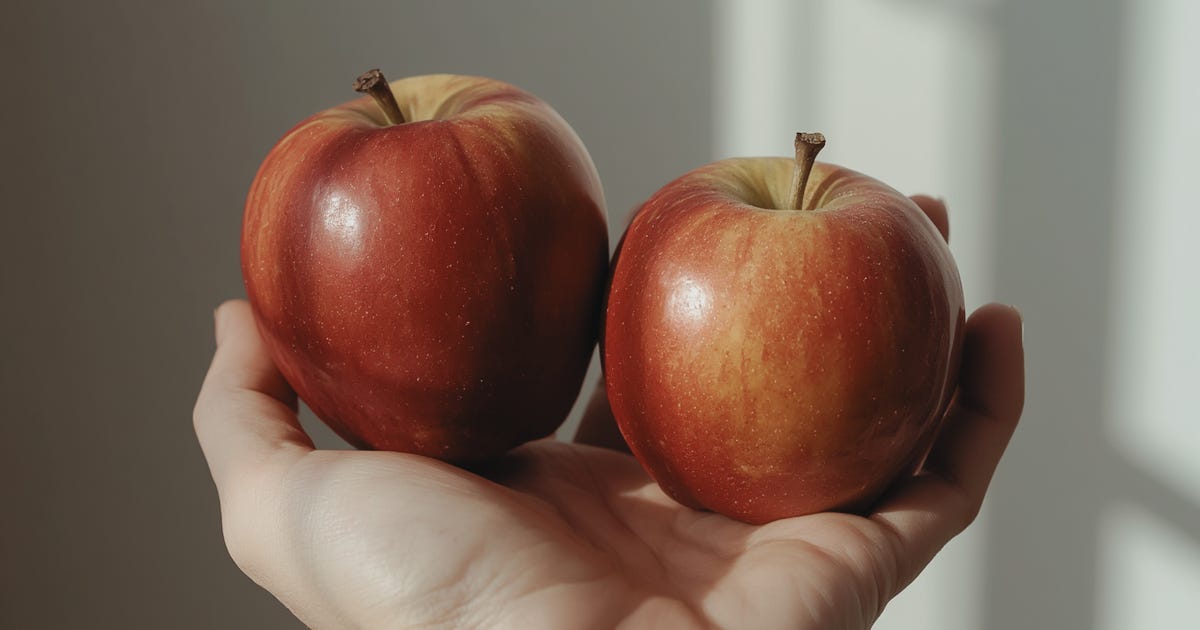
Sometimes the first camp has a point, although it is often massively overstated. Sometimes the second is exactly what we need, especially when making guidelines or trying to stop people being frightened away from things that are genuinely good for them. But most of us are not writing guidelines. We are standing in a supermarket aisle, wondering whether the normal apples are fine, whether the organic ones are worth the extra money, and whether we are a terrible person for not having the energy to care today.
We have limited attention. Limited money. Limited time. Limited emotional energy. Many of us are trying to make these decisions while tired, busy, and surrounded by snacks. Worry is a finite resource, and health content has become very good at draining it. The fear-based side is stressful enough on its own. It is even worse when it is followed by a discount code. The dismissive side can be frustrating too, though sometimes it is absolutely right: the evidence really is weak, the claim really is nonsense, and the fear really is doing more harm than the thing people are frightened of. Though sometimes I wonder if reasonable questions get dismissed too quickly. We can talk as though the case is closed when in reality there is still uncertainty.
Why it’s not always simple
The annoying thing is that some of these questions are actually quite hard to answer. Nutrition, pesticides, plastics, air pollution and all the other things that sit in the background of modern life do not lend themselves to neat experiments or simple answers.
Is this exposure harmful at normal levels? What about over years? What about mixtures? What if the effect is small but repeated? What if the study is too short, the exposure is hard to measure, or everyone is exposed so there is no proper comparison group?
Take pesticides. On one side, you have claims that they are poisoning us, destroying our health and causing cancer. On the other, you have people saying residues are well below regulatory thresholds, organic food is mostly a marketing ploy, and there is no good evidence of harm. I understand why the second argument exists — we should not be scaring people away from fruit and vegetables, because eating more plants is one of the things we have much better evidence for. But I also don’t think the question is stupid.
We cannot ethically give one group of people high doses of pesticides for decades and see who gets ill. So we end up relying on lab studies, mechanistic work, biomonitoring, observational studies and a lot of uncertainty. People who eat organic food often differ from people who do not in many other ways: income, education, lifestyle, health behaviours, and general levels of neurotic label-reading. It is hard to untangle.
Which is a very long way of saying: I can see why people feel confused.
The basics still matter most but they are hard
Most of the time, the things we already know about matter more than the things we are worrying about. Food packaging chemicals are not more important than sleep. Pesticide residues do not matter more than eating enough vegetables. Sunscreen ingredients do not deserve more attention than avoiding sunburn. Exercise, weight training, a minimally processed diet, decent sleep, not drinking too much, not smoking, getting outside, having actual conversations with other humans — we all know the list.
What is less often said is how hard that list actually is to action, and how unevenly the conditions for doing so are distributed. I do believe we have some control over our health, though not total control and not always equal control — genetics, money, time, work, caring responsibilities and plain bad luck all have a vote too. That distinction is important to me because there is a version of modern wellness that turns illness into a personal failure. If you get sick, you didn’t eat clean enough, detox properly, regulate your nervous system, or optimise the right morning routine. I don’t believe that. Sometimes people do a lot right and still get ill. Sometimes people do very little right and live to 96. Health advice should help people find what they can change. It should not turn suffering into a character flaw.
The basics are not conceptually hard, eating vegetables does not require a PhD, but doing them consistently means restraint, discipline, and often saying no to things that are often genuinely lovely. I like healthy food, I really do, but it is still an active choice. Would I also like to go to the bakery and eat as many pastries as I want? Absolutely. Do I feel better after exercise? Yes. Do I sometimes enjoy drinking wine with friends more than putting on trainers? Also yes. So I can see why we get pulled towards the smaller things. I can be panic-Googling PFAS in cookware while stress-eating sweets, when arguably the more evidence-based intervention would be to put the phone down, go for a walk, and stop worrying about the pans.
How I decide what deserves attention
How I decide what deserves attention
I don’t think the smaller things are automatically nonsense either. “No strong human evidence of harm” is not always the same as “we know this is harmless.” Sometimes it means the effect isn’t there. Sometimes it means the exposure is difficult to measure, we are following people for too short a time, or we are studying one chemical at a time when real life is a mixture. Mechanistic studies are not proof of human harm, and I don’t think every cell-culture study deserves a lifestyle change but it doesn’t mean that they are completely irrelevant.
The question I keep coming back to is: does this deserve my bandwidth?
How strong is the evidence? How often are we exposed? How difficult is the change? And is this distracting me from something more important? If something seems plausible, exposure is repeated, and the swap is easy, I am more willing to change the default while the evidence catches up. If the change makes life harder, more expensive, more restrictive, or more anxiety-provoking, I am less interested.
Where I get more suspicious is when thin evidence gets dressed up as certainty, especially when the next step is a checkout page.
Collagen is a good example. The evidence is fairly limited, the effects modest at best, and the products are often expensive. Yet if I spend long enough on social media, I can find myself wondering whether I am somehow neglecting my skin, health and future vitality by not taking it. That is the thing I find fascinating. I know how to read a paper. I know the evidence is far from settled. And yet repeated exposure to confident people telling me I should be doing something still creates the feeling that I am falling behind.
I am not bothered by someone trying collagen because they like it. If it makes them feel better, more confident, or simply gives them the feeling they are doing something positive for themselves, that is their choice. What bothers me is when someone with credentials talks as though the case is settled, builds fear about ageing, skin or hormones, and then produces a discount code for something that costs more than my weekly food shop. It is exactly the sort of thing that makes it harder to work out what actually deserves our attention.
What I’m trying to do here
So that is what I am trying to do here: spend the worry better. Work out what actually deserves our limited time, money, energy and attention, and what is just very good at making itself seem urgent.
Someone said to me recently that whenever you read about evidence, you are also reading someone’s interpretation of the evidence. I think that is true. There is always judgement involved: which studies you give most weight to, how you handle uncertainty, what you consider a meaningful risk, and what trade-offs you think are worth making. That is partly why I wanted to write this piece, not just to tell you what I think, but to show you how I think.
Some of you are new here, so a bit of context. I trained as a dietitian, worked briefly as one while applying to medical school, then went to medical school and worked as a doctor for around five years. I'm currently on a small hiatus from clinical medicine, working in a small tech company while raising young children. This newsletter is partly my thread back to medicine. It is also an attempt to make some use of the ridiculous amount of time I have spent overthinking about these things.
The honest answer is that there are very few health topics I haven’t spiralled over and obsessively researched in the past few years. Sleep deprivation, an interest in health, losing a parent to cancer, and a medical degree can be a bit of a dangerous combination. Over time, I realised that friends, family and even other doctors would come to me with these questions because I had usually already gone down the rabbit hole. Not because I have all the answers, but because I’m the person who will actually go and read the paper, check the limitations, and then say: I think this is worth caring about, or I really wouldn’t lose sleep over this.
I know some people want a simple answer, and I understand that. These questions are exhausting and certainty is appealing. But a single rule does not fit everyone. Someone in their mid-thirties with young children and a demanding career is doing a different calculation than someone in their seventies with more free time and a reasonable interest in the smaller things that might accumulate and matter at the margins.
So I will share how I think about things and what I would do, but I will try not to tell you what you must. I am not here to tell you everything is toxic, and I am not here to pretend every concern is silly until the evidence is perfect.
I am just trying to work out what deserves my attention, and what is very good at making itself seem urgent.
That is really what this newsletter is: an attempt to spend my worry better.
If you've ever found yourself going down the same health rabbit holes, you might enjoy:


Really thoughtful perspective highlighting an important principle in toxicology: context matters. As Paracelsus famously noted, “the dose makes the poison.” Virtually everything, including water, oxygen, sunlight, and essential nutrients, can be harmful under certain conditions, and risk depends not only on exposure, but also on dose, duration, and individual susceptibility. At the same time, I appreciate the reminder that acknowledging nuance should not dismiss legitimate environmental concerns. The goal is neither fear nor complacency, but evidence-based risk assessment that helps us prioritize the exposures that truly matter rather than becoming overwhelmed by the impossible task of avoiding everything. In an age of information overload and health anxiety, it’s refreshing to remember that good health is less about eliminating every potential toxin and more about understanding relative risks and focusing on what meaningfully influences long-term well-being. Thanks for sharing this insightful piece.
Enjoyed this perspective. All things are toxic. Fear can sharpen judgment or cloud it. Frightened audiences are attentive and dependent, and the capacity to amplify and monetize fear is real. Ask who benefits from your alarm and ask the same of others seeking complacency.Allocate time & resources where they reduce stress and uncertainties. Bark less, wag more. Be humble and kind.